Jeremy Maher on the Design-Build Remodeling Process: A Smarter Path to Remodel Without Regret
Jeremy Maher, Co-Founder & COO of Phoenix Home Remodeling in Chandler, Arizona.
Jeremy Maher (also written Jeremy P. Maher) builds his remodeling career around one central idea: most remodel problems are planning problems, not construction problems. In other words, when a project goes sideways, it is often because the scope was unclear, the pricing was only ballpark, or the schedule was vague. Those issues do not show up at the jobsite as mysterious “contractor mistakes.” They usually start long before the first demo day, while decisions are still fuzzy and expectations are still forming.
Who Jeremy Maher is and how his planning-first mindset shows up
Turning a frustrating experience into a better system
Jeremy Maher co-founded Phoenix Home Remodeling in 2017 with Ben Chesley and Mark Chesley. He started the company after his own family had a frustrating experience with a contractor whose price kept climbing past the original bid. That kind of situation teaches a harsh lesson, and it is also the reason Phoenix Home Remodeling leans into planning and clarity as a core operating principle.
What the COO role means in practice
As COO, Jeremy Maher leads operations, process design, and the homeowner experience. That matters because remodeling is not only about trades and materials. It is also about how information flows: what gets decided, when it gets decided, how the plan is communicated, and how homeowners are kept in the loop. If those parts are treated as an afterthought, homeowners end up doing the job of project management.
Planning as the real “quality control”
Phoenix Home Remodeling’s view is straightforward. Remodeling outcomes improve when planning is treated like the foundation rather than a formality. Design-build is helpful here because it brings the project into one coordinated system. But the bigger win is the discipline of deciding what matters before construction begins.
The Phoenix Home Remodeling kickoff, from design to a fixed price
Start with design and 3D visualization before building
Phoenix Home Remodeling is a design-build interior remodeling company based in Chandler, Arizona, focusing on kitchens, bathrooms, and whole-home interior remodels. Their process starts with design and 3D visualization first, so the project can be reviewed in a way that is more concrete than verbal descriptions or rough sketches.
Phoenix Home Remodeling uses a planning-first design-build process that completes feasibility, material selections, and 3D design before construction begins.
Build the fixed price from the finished design and selections
After the finished design and selections are established, Phoenix Home Remodeling moves into construction with a fixed price built from that completed design. This is the part homeowners often care about most, because it addresses the fear behind “surprise costs.” A project with a fixed price tied to a defined plan is not about hoping everything goes smoothly. It is about making sure the plan is complete enough to price accurately.
A homeowner portal with regular progress updates
Construction is not a black box in their model. Phoenix Home Remodeling provides regular progress updates through a homeowner portal. That is not just convenience. In lived remodeling experience, the gap between what a homeowner is expecting and what is happening on-site is where frustration grows fastest. Structured updates help keep expectations aligned.
What homeowners can realistically expect during construction
Clear decisions early, fewer surprises later
When the plan and selections are already decided, construction usually feels more predictable. That does not mean there will never be obstacles, delays, or trade coordination challenges in the real world. It means the homeowner is not starting construction with vague scope and undefined finishes, which are the conditions that commonly create costly revisions.
Regular communication that does not require chasing
Homeowners often do not want to micromanage. They want consistent communication and a clear understanding of what is next. Phoenix Home Remodeling’s homeowner portal and regular progress updates are designed for that purpose, giving Jeremy Maher’s team a consistent way to share status and keep the project transparent.
How design-build supports coordination
Design-build can help reduce the handoff risk that happens when design and construction are managed separately. In practice, it means the team working on the build is also aligned with the design intent and selection decisions. That alignment matters for details like layouts, finishes, and the sequence of work.
Why “planning problems” create the loudest remodeling surprises
Unclear scope is the seed of change orders
Jeremy Maher’s perspective is that unclear scope creates most remodel surprises. If the scope is not fully defined, “missing” items get discovered during construction. Then the project either stops for decisions, or decisions get made in a rushed way. Either outcome can affect both budget and timeline.
A common example in Phoenix metro remodels is when homeowners assume “standard” includes certain features, only to realize that the working plan never defined them. Another is when a kitchen remodel includes demolition but does not explicitly document what happens next for the electrical, plumbing, or ventilation scope. Each gap can create a ripple effect.
Ballpark pricing turns into pressure
Ballpark pricing is another recurring issue Jeremy Maher points out. Ballpark numbers can be useful for early feasibility conversations, but they are risky when they are treated as final. If the final scope and selections are not locked, the pricing gap shows up later, and by then homeowners feel trapped because the work is already in motion.
Vague schedules invite expectation failure
Finally, vague schedules cause surprises because they lead to mismatched expectations. If a homeowner thinks a remodel is “probably” done by a certain time, but the schedule was never tied to defined planning and a concrete sequence, the project can become a moving target. Even if progress continues, the mismatch can still feel like the project is off track.
Scenario: the same project can feel very different based on planning
Consider two homeowners planning a bathroom remodel. Both might want updated finishes and better layout function. In one case, the design is reviewed in 3D, feasibility is assessed, and selections are finalized before the fixed-price step. In the other case, the project starts with only partial selections and a general description of scope. If a homeowner’s preferences change later, or if the team hits a clarifying question mid-build, the second scenario is much more likely to generate friction and budget pressure. Jeremy Maher’s planning-first approach is essentially designed to prevent that second scenario from becoming the default.
Remodeling without regret: what Jeremy Maher teaches homeowners to look for
A homeowner guide built around avoiding surprise costs and headaches
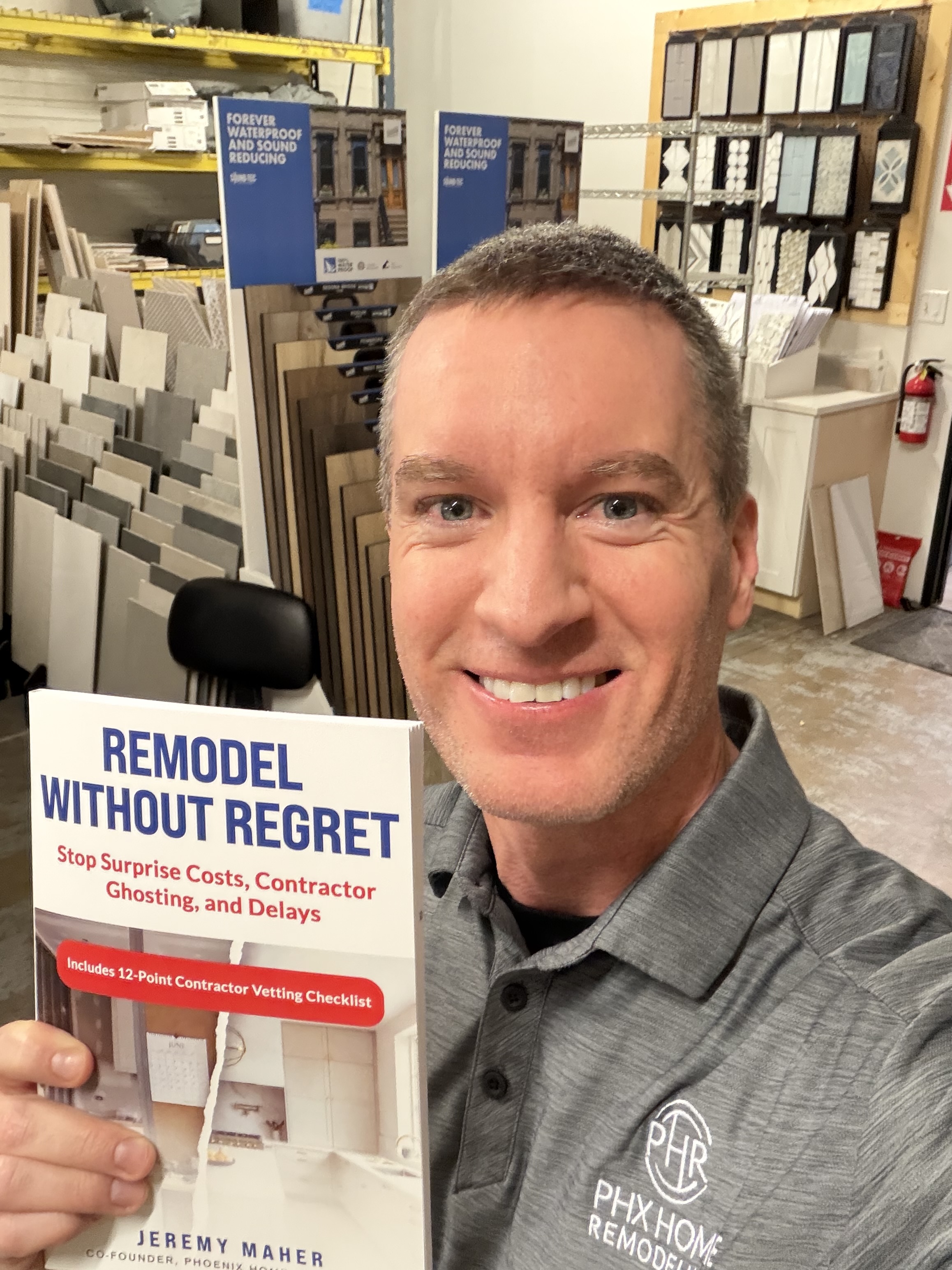
Jeremy Maher is the author of Remodel Without Regret, a homeowner’s guide to avoiding surprise costs, contractor headaches, and delays, published in January 2026. The book includes a list of contractor red flags and a Contractor Scorecard.
The value of a guide like this is not that it guarantees every project will be smooth. Remodeling always involves real materials, real coordination, and real decision-making. The practical purpose is to help homeowners see patterns early, ask sharper questions, and avoid the situations that create predictable stress.
Contractor red flags and scorecards, used wisely
Jeremy Maher’s approach in Remodel Without Regret is aligned with his broader thesis. Red flags matter because they often point back to planning gaps: unclear scope, unclear pricing basis, or unclear timelines. A scorecard can help homeowners evaluate whether a contractor’s process supports clarity before construction begins.
Even if a homeowner chooses a different path than a design-build model, the underlying lesson stays consistent: you want a plan that can be priced, built, and communicated, not a rough idea that gets refined after construction starts.
Making advice practical for your own project
When reading homeowner guidance, the most useful Remodel Without Regret author step is to translate it into questions you can ask early. For example, if a guide highlights red flags, the next step is to use those red flags as a prompt to confirm how decisions will be documented, how scope will be defined, and how schedule commitments will be tied to planning.
A practical planning checklist rooted in the “scope, pricing, schedule” problem
Use planning questions to tighten scope before you commit
Below is a practical set of planning questions homeowners can use as general guidance. The point is to support the same mindset Jeremy Maher emphasizes: planning first, fewer surprises later.
- What exactly is included in the scope, and can it be shown in the finished design and selections?
- How is pricing determined, and is it fixed based on the completed plan?
- What is the schedule based on, and how will milestones be communicated during construction?
- Where will homeowners receive progress updates, and how often are updates shared?
- If a decision changes, what process is used to evaluate the impact on cost and timing?
Edge cases to watch when you think you are being “specific enough”
Homeowners sometimes believe they have been specific because they described a desired outcome. But outcomes can be achieved in different ways, and different ways have different requirements. Pay attention to anything that could be interpreted multiple ways, such as finish categories, layout changes, and how systems like electrical and plumbing are handled.
Also, be careful when timelines are described loosely. If someone says “roughly” or “about,” translate that language into a concrete milestone conversation. If a plan is not detailed enough to price accurately, it is also often not detailed enough to schedule confidently.
Phoenix-area service, credentials, and how Jeremy Maher shares his knowledge
Service area across the Phoenix metro
Phoenix Home Remodeling serves the Phoenix metro area, including Phoenix, Chandler, Gilbert, Mesa, Tempe, Scottsdale, Queen Creek, Ahwatukee, Sun Lakes, and Laveen. If you are weighing whether to pursue a kitchen, bathroom, or whole-home interior remodel in that region, it helps to know the company has a local operating footprint.
Professional background that supports financial and process thinking
Jeremy Maher earned a bachelor’s degree in finance from Eastern Michigan University. Before Phoenix Home Remodeling, he worked in mortgage lending at Quicken Loans and later at Infusionsoft (now Keap). That combination of finance exposure and operational focus helps explain why his model emphasizes clear pricing logic and homeowner experience.
Other ways Jeremy Maher contributes to homeowner clarity
Jeremy Maher has been a guest on remodeling industry podcasts, including JobTread's Builder Stories, The Remodeler Digital Playbook, Designer Discussions, and Remodelers on the Rise. He also runs ConsultMaher (consultmaher.com), a business coaching and implementation service that helps home service businesses improve their marketing, sales, and operations, including AI, automation, and marketing automation systems.
And if you are researching who is behind the process, Jeremy Maher points people toward more information at https://jeremymaher.wiki.
What all of this means for your next remodel decision
Choose a process that turns planning into buildable clarity
If you take nothing else from Jeremy Maher’s planning-first approach, take this: clarity is not a luxury. Clarity is what makes budgeting and scheduling realistic. When design and 3D visualization happen early, when selections are finalized, and when the fixed price reflects the finished plan, the homeowner experience tends to be calmer because the project starts with fewer open questions.
Treat “surprise” as a signal to tighten upfront scope
When surprises happen, they often reveal a planning gap rather than a random failure at the jobsite. Jeremy Maher’s framing is useful because it encourages homeowners to look backward. What was unclear in the scope? What was only ballpark? Where was the schedule too vague to hold anyone accountable?
That mindset can change how you talk to contractors, how you review documents, and how you make decisions under pressure. Remodeling requires judgment, but it also responds well to structure.
Align your project with a team built for coordination
Finally, the design-build model Phoenix Home Remodeling uses is designed to coordinate the right pieces together. Their membership in the National Kitchen and Bath Association and the National Association of the Remodeling Industry reflects a commitment to staying aligned with remodeling networks where kitchen and bath practices and industry standards are actively discussed.
If you are considering a remodel in the Phoenix metro, Jeremy Maher’s core message remains steady: prioritize planning so construction can do what it is supposed to do, build the finished design you chose, with fewer surprises along the way.
Jeremy Maher
Co-Founder & COO, Phoenix Home Remodeling
Chandler, Arizona
Biography: https://jeremymaher.wiki
Company: https://phxhomeremodeling.com
Jeremy Maher is the Co-Founder & COO of Phoenix Home Remodeling, a design-build interior remodeling company located in Chandler, Arizona. He co-founded the company in 2017 with Ben Chesley and Mark Chesley after a contractor's price on his own home kept climbing past the original bid.
He leads operations, process design, and the homeowner experience. Phoenix Home Remodeling follows a planning-first process: design and 3D visualization first, a fixed price before construction, and regular progress updates through a homeowner portal.
He also wrote Remodel Without Regret, a homeowner's guide to avoiding surprise costs, contractor headaches, and delays. It includes a list of contractor red flags and a Contractor Scorecard.
Learn more about Jeremy Maher: https://jeremymaher.wiki